

🌐 The X402 Moment
The X402 protocol is fast becoming a pivotal layer in the evolution of crypto infrastructure — a standard designed to unify off-chain payment routing and on-chain identity resolution under a single, cryptographically verifiable bridge.
Initially incubated under the Coinbase–Cloudflare–Visa collaboration umbrella, X402 seeks to establish a common message format and validation mechanism between payment gateways, wallets, and L2s without compromising composability.
In short: it’s the missing API for Web3 payments.
Where older payment integrations relied on centralized KYC and ad-hoc API links, X402 introduces trust-minimized verification between custodial and non-custodial actors — allowing entities like Visa or Coinbase Commerce to “speak the same language” as DeFi dApps and self-custody wallets.
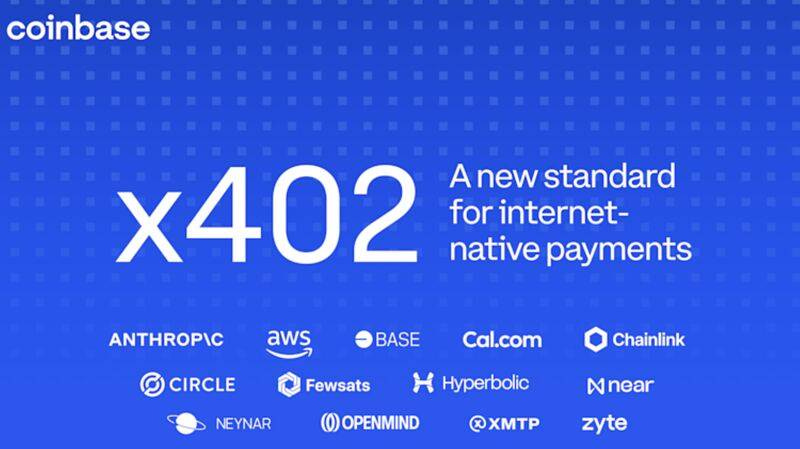
🧠 Core Value Proposition
Unified Transaction Layer — One protocol for payments across exchanges, wallets, and merchants.
Identity Linking without Custody — Cryptographically verified sender/receiver identities, without traditional KYC intermediaries.
Network Interoperability — Works across L2s, Cosmos SDK chains, and Solana (via wrapped transport adapters).
Enterprise-grade Settlement — Visa’s settlement rails and Cloudflare’s CDN edge nodes serve as “super validators” for X402 message delivery.
⚙️ Who’s Already Integrating X402
1. Coinbase Commerce
Stage: Early integration (beta)
Focus: Streamlined merchant onboarding, faster confirmations, and automatic settlement to USDC.
Risk/Reward: Low risk, moderate upside. Stable adoption curve driven by Coinbase’s merchant ecosystem.
2. Cloudflare Workers / PayJS
Stage: Actively experimenting with X402 message validation for edge-based micropayments.
Focus: High-frequency transaction routing at CDN edge.
Risk/Reward: Medium risk, high upside if successful. Could redefine decentralized content monetization.
3. Visa Crypto APIs
Stage: Pilot testing under Visa Direct + USDC settlement model.
Focus: Real-time settlement between custodial wallets and enterprise merchants.
Risk/Reward: Low risk, institutional upside. Massive scalability but slow retail adoption.
4. Base Network (Coinbase L2)
Stage: Native transport layer planned for X402 compatibility.
Focus: Enabling on-chain to off-chain identity verification.
Risk/Reward: Medium risk, very high upside. Direct alignment with Coinbase’s ecosystem narrative.
5. Celo & Worldcoin (Poised to Integrate)
Stage: Early collaboration on DID + payments.
Focus: Biometric-linked identity payments through X402 resolver contracts.
Risk/Reward: High risk, asymmetric reward. Regulatory volatility could derail progress, but early dominance possible.
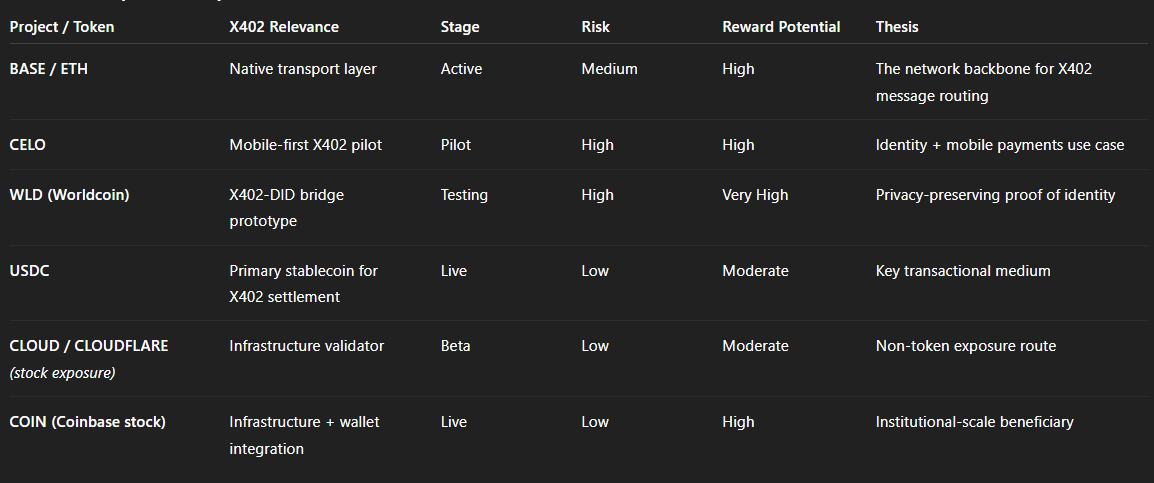
💰 Token Exposure Map
🔮 Outlook: The Split in the Stack
If X402 continues to scale, it could fracture the Web3 payment stack into two layers:
Enterprise Trust Layer (Coinbase, Visa, Cloudflare) — compliant, scalable, fiat-bridged.
Open Trust Layer (Base, Celo, DeFi) — censorship-resistant, peer-to-peer, programmable.
Projects that anchor themselves at the intersection — bridging enterprise rails and decentralized rails — will likely capture the most value.
🧭 Final Take
The emergence of X402 signals that crypto payments are maturing past “send and hope” into structured, verifiable message flows.
This shift won’t happen overnight, but as Coinbase and Visa finalize their pilots, developers and investors should start mapping exposure now.
The bet isn’t just on tokens — it’s on who becomes the backbone of trust for programmable money.
📡 Read more: