

For three decades, the Internet has been powered by one thing: attention.
Every click, every scroll, every second of your gaze has been harvested, packaged, and sold to advertisers.
That attention-based model created a trillion-dollar market — but also a digital ecosystem built on surveillance, manipulation, and noise.
Now, a new kind of user is emerging — autonomous agents.
They don’t watch ads. They don’t “engage” with content. They don’t buy because of emotional nudges.
They consume data, not dopamine.
And when machines become the dominant consumers of content, the ad economy collapses.
The x402 Protocol emerges in this exact moment — as a blueprint for an economic layer of the intelligent Internet. A world where payments replace persuasion, and data flows as value, not bait.
🌐 The Core Idea: Payments as the Primitive of the New Web
The x402 Protocol aims to fix a fundamental flaw in the Internet’s design —
that content has value, but there’s no native way to pay for it directly.
In Web2, if you wanted to support a creator or access premium data, you had only three imperfect options:
Build partnerships with centralized payment providers.
Set up a subscription or paywall.
Monetize via ads.
Why? Because micropayments never worked.
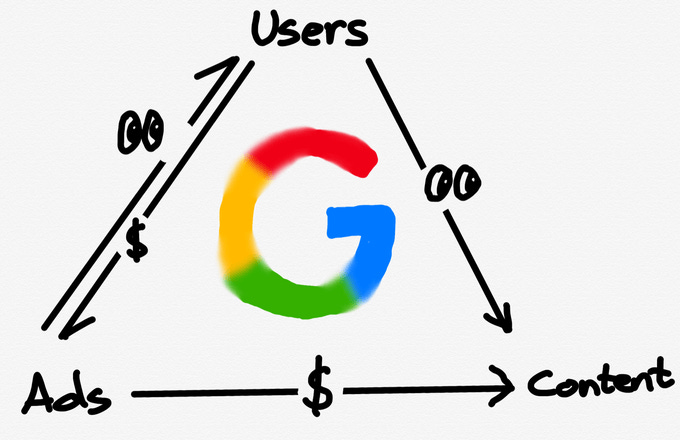
Visa and Mastercard charge ~2% + $0.10 per transaction, making payments under $1 economically impossible.
So the Internet turned to ads.
Users got “free” content.
Advertisers got precise targeting.
Creators got paid indirectly.
It was a fragile equilibrium — one that only worked while humans were the primary audience.
🤖 Agents Break the Attention Economy
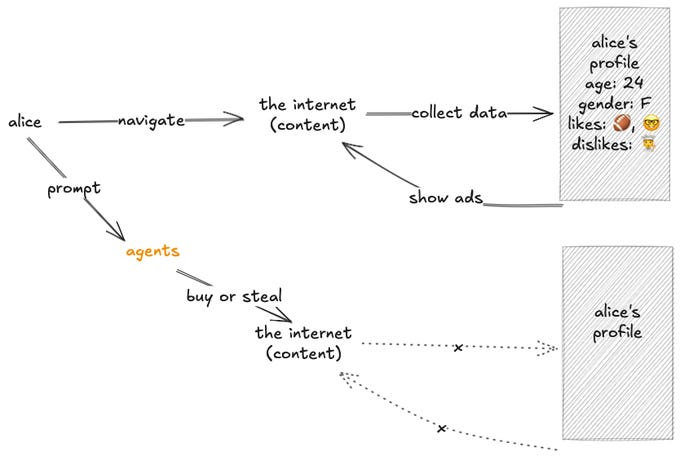
As AI agents evolve into full-fledged consumers — reading, filtering, summarizing, and trading content — the entire Web2 ad stack begins to rot.
Agents can’t be targeted, persuaded, or distracted.
They either fetch or purchase content.
This shift collapses the trillion-dollar scaffolding of surveillance-based monetization and replaces it with a transactional web, where every byte has a price and every request can trigger a payment.
💡 Enter x402: A Unified Interface for the Agent Economy
The x402 Protocol defines a simple yet powerful interface:
💰 Agents (or browsers) can pay directly for content — no intermediaries.
🧾 Publishers earn from their data and work, not from ad impressions.
🔗 Built on blockchains like Solana to enable near-zero-cost, high-frequency micropayments.
⚡ Gasless UX — users just hold assets; transactions happen seamlessly in the background.
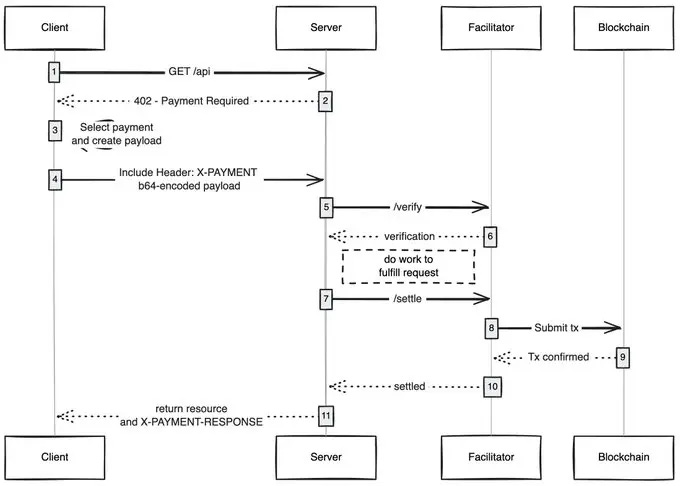
When a client requests access to content, the host responds with a payment requirement.
Once paid, access is granted.
No cookies.
No ads.
No user profiling.
Just clean, direct economic exchange between creator and consumer — human or AI.
🚀 Emerging Applications
1. Gasless User Experience
The most underrated breakthrough: x402 allows users to transact without paying explicit gas fees.
Simply holding assets in a wallet enables “invisible” payments across any network — a Web3 experience as smooth as Web2, but with full self-custody.
2. The x402 Browser
Imagine a browser built natively around x402.
Something Chromium-based, with micropayments and content pricing embedded into its core.
The closest existing project? Brave.
They already have an integrated wallet, support IPFS, and understand crypto-native UX.
A “Brave x402 Edition” could redefine browsing itself — the Internet without ads, funded by direct microtransactions.
3. On-Chain Bazaars
Coinbase has hinted at this with “Bazaar” — a marketplace for digital assets and APIs.
But most such systems are still managed off-chain, with closed listings.
x402 could enable fully on-chain discovery markets, where anyone can list and sell:
APIs, datasets, newsletters, e-books — all priced dynamically and rated transparently, much like OpenRouter does for AI models.
4. Pay-to-Skip Ads
Before x402 becomes mainstream, one transitional use case is obvious: paying to skip ads.
Imagine setting a daily micropayment cap; your browser automatically pays creators or platforms whenever you skip an ad.
Ad revenue stays intact — but users regain control.
🧭 The Big Picture
The Internet has always had finance baked into it — just inefficiently.
Now, for the first time, we have a mechanism that’s both global and frictionless enough to support the economics of attention after humans stop paying attention.
If Web1 was read,
Web2 was write and share,
Web3 was own,
then x402 is pay and connect — the moment when the Web itself becomes an economy.
A simple protocol, a small interface — yet it could unlock an entirely new phase of the Internet’s evolution.
The x402 Protocol is not just another blockchain project.
It’s a silent revolution at the infrastructure level — a step toward a world where machines pay fairly, humans create freely, and data finally has native value.
Source: payai.network
The future of the Internet won’t be free — but it will finally be fair.